
NINA ROZA - CAMBRIDGE FILM FESTIVAL
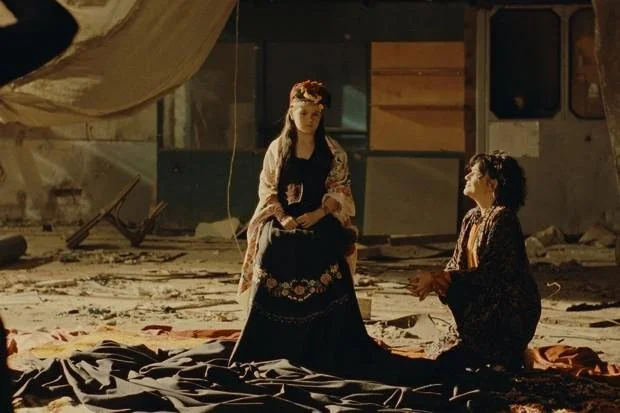
Here's a question. Actually, two questions. Where is home? And what is home? When we leave our homeland behind, what remains of us? Does nostalgia eventually turn to regret? And are we, in some way, cast adrift when we put down roots somewhere else? These are the questions magnificently posed by Nina Roza, a beautiful and deeply affecting film from the rising Quebecois director Geneviève Dulude-De Celles.
Mihail (Galin Stoev) is an art expert living and working in Montreal, although his roots lie in Sofia, Bulgaria. His daughter and grandson live nearby, but his wife has died, leaving our central character bereft in more ways than one. He has made a successful new life for himself, but at some considerable cost. His adopted world is one of sterile, white-walled galleries, fashionable art and sophisticated collectors. His past, however, lies in the colours, sounds, music and warmth of his native land.
When Mihail is dispatched to Bulgaria to investigate the authenticity of paintings by an eight-year-old artistic wunderkind, he finds himself confronting a country he has spent almost thirty years trying to forget. The young artist, Nina, lives a simple life in a rural village, surrounded by goats, family and warm-hearted locals. Her extraordinary paintings have attracted international attention, and there is money to be made if her talent can be successfully marketed to the outside world.
But should Mihail encourage the young girl to leave behind her family, language, music and everything familiar to her? Might she, in pursuing artistic success, become another educated but uprooted outsider like himself? There is a delicious irony here. Mihail has spent his professional life assessing and placing a value on art, yet has been rather less successful in recognising the value of his own cultural inheritance. He knows how to curate a collection but has never quite managed to curate his own life, or indeed his relationship with his daughter Roza. The film explores these dilemmas with painterly beauty. Cinematographer Alexandre Nour Desjardins gives us a Bulgaria of astonishing colour and texture, in striking contrast to Mihail's ordered Canadian existence. The pace is languid without ever becoming tedious, while the intimate, sometimes restless camerawork lends the whole film a subtle sense of disequilibrium. We are never quite on firm ground, just as Mihail himself is never entirely at ease.
And what a performance from Galin Stoev. His wonderfully rugged, careworn face — think a Bulgarian Mick Jagger — seems to carry the accumulated disappointments of a lifetime. The camera lingers on it in extraordinary close-up, finding more in a glance or a furrowed brow than pages of dialogue might reveal. There are also blurred, dreamlike glimpses of the past, reminders of a once-happy father and his creative young daughter, whose emotional needs he perhaps never properly understood. Ekaterina Stanina as Nina is also outstanding and a name to watch.
Joseph Marchand's poignant, haunting score adds another dimension, quietly echoing Mihail's inner landscape of grief, memory and uncertainty. Music, like language, becomes one of those invisible threads connecting us to the places and people we have left behind. What makes Nina Roza so compelling is that it refuses to offer easy answers. Home is not necessarily where we were born, nor is it simply where we happen to live. We can escape a country, but can we ever really escape the person we were when we lived there?
This is a gorgeous, intelligent and profoundly moving film, one that deserves a wide audience. It has already won the Silver Bear for Best Screenplay at Berlin and is Canada's submission for the Academy Awards. I wouldn't be at all surprised if it goes further. Above all, Nina Roza will make you think about home — and remind you that it is often where the heart is not.