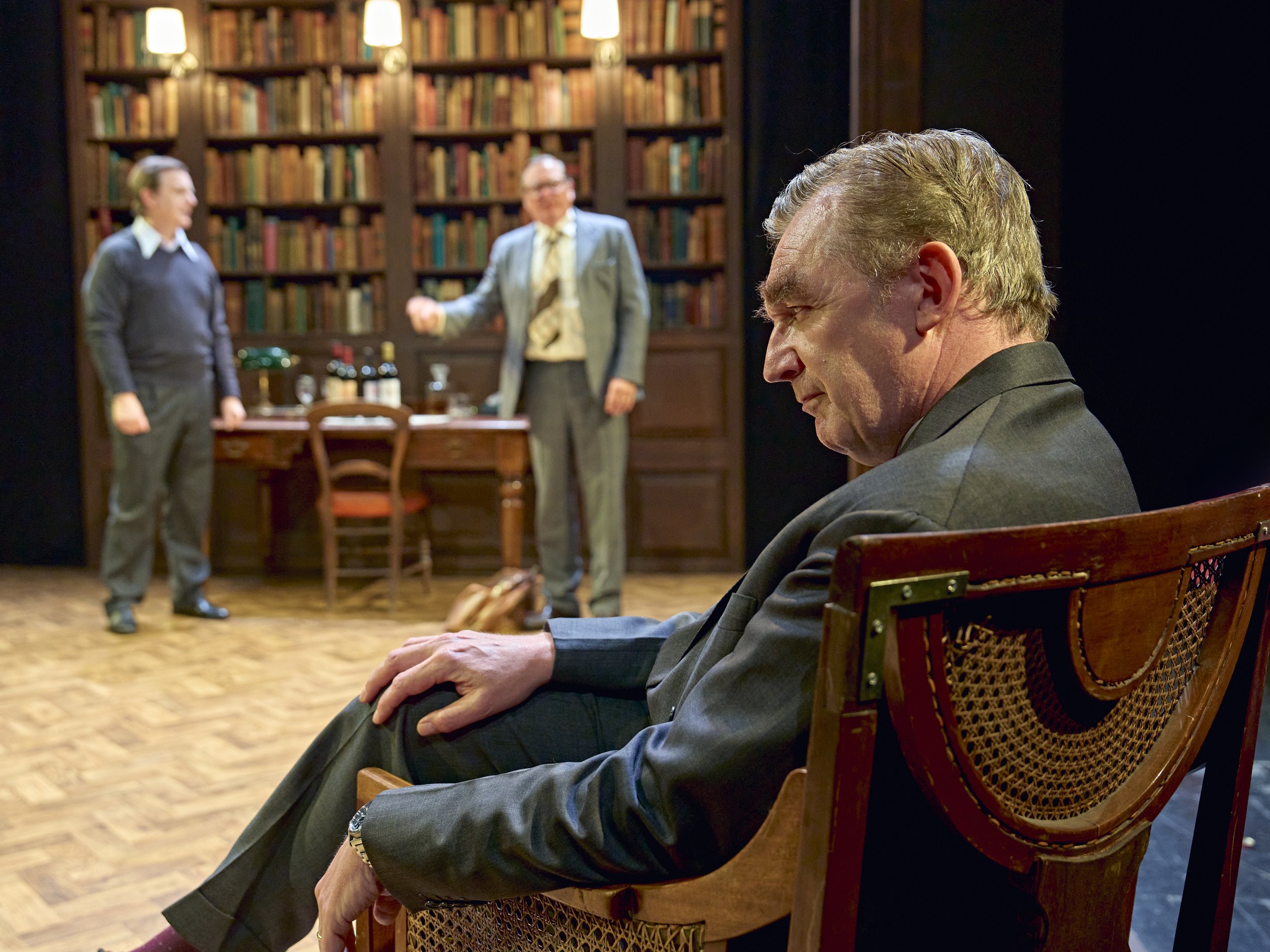
The Gang of Three Alan Cox Hywel Morgan Colin Tierney as Anthony Crosland Roy Jenkins and Denis Healey
How many theatregoers remember that remarkable slice of British political life when a battered and beleaguered Labour Party, once with the wind its sails, hit stormy waters Eventually they looked set to launch their own boat, the Social Democratic Party. In a revolutionary rebellion against the leftists of the Party, they make a bid to take over the entire opposition to the threat of Margaret Thatcher and her radical right wing agenda. They nearly turned the tide of history.
This play examines its inception through the lively life-long relationship between players, Roy Jenkins and Anthony Crosland, who brought their values to a new approach to politics.
Alan Cox was perfect as the debonair and dashing radical reformer Anthony Crosland. He made the running for stylish and super-witty discontent in an opening scene in the elegant home of Roy Jenkins, a superbly acted Hywel Morgan. The badinage between the two old friends – they were rivals at Oxford, was brilliantly conceived by writers and producers, Robert Khan and Tom Salinsky. It made for stimulating political stuff.
“You invented the Sixties”, Jenkins announces admiringly of the man he worked alongside in a government of change. Depicted as an entertaining camp gay, Tony had steered through the legislation to cancel the vicious laws against homosexuality and bring in legislation to change the landscape of sexual relations in Britain forever. No small feat against a sea of conservative opposition. Tony was not a modest man. He rightly claimed success in abolishing the hegemony of grammar schools, the coming of Comprehensives and the invention of Polytechnics in a world where a few universities dominated the higher education world.
That is how high the stakes were back in the 1960s and 70s. Equally, Roy Jenkins was a titan of change as Chancellor as he applied his family values to the financial structure of the country. His father had been a campaigning Trade Unionist –a background belied by his bon viveur lifestyle
The dialogue between the two college friends, sometimes hostile often affectionate suffused this drawing room sequence with vitality and savage innuendo. Roy Jenkins is excoriated for his passionate adhesion to the EEC a a cause he resigned over when Labour refused to have anything to do with Europe. Anthony Crosland is the brilliant mind behind so much radical change, but far more bold than his old College mate
“If you make mistakes”, he advises “always make them new mistakes”.
It is a surprise when the scene shifts to 1940 in Balliol College where young Roy Jenkins hides from the world in chagrin. Failure to capture President of the Union has cut deep. He can’t get out of bed for shame in defeat. Only when Tony appears and turfs him out of it and blasts a wickedly funny rallying speech at him, does he recover. As Tony says “You think too much about what people think of you” He, by contrast does not. Casually he announces his decision to sign up, “Someone has to stop him” he murmurs.
By this time in the play we have met Denis Healey, the swashbuckling Chancellor to Prime Minister Harold Wilson. He famously declared he would ‘Squeeze the rich until the pips squeak”. Colin Tierney was cool in the role. He even looked like Healey with his bushy eyebrows. But a dominant figure for any group of Three or Four. His collaborators declare ‘ But for your short temper you would have been Prime Minister” – a charge he immediately demonstrates with a mighty roar of discontent.
A great play – there was even sorrow among the snarky vituperative wit. When the two survivors remember the coruscating Anthony Crosland’s death, they silently grieve at the loss of such brilliant friend. Especially Roy.
On refection the whole enterprise has a distinctly local Cambridge core. Shirley Williams, the vivacious colourful centre of events along with David Owen, glamorous Foreign Secretary. Shirley stood for election in Cambridge, confident her moderate, platform would have massive appeal. But she lost. The Gang of Four , once confident of a new dawn of governance, failed
In the audience were many who had canvassed for her Social Democratic Party, and those who stuck with the more radical Labour of Michael Foot and Tony Benn – and someone, the Gang can’t remember his name young Malcolm Corbyn ?