TUDOR CONTEMPORARY AT THE HEONG GALLERY DOWNING COLLEGE
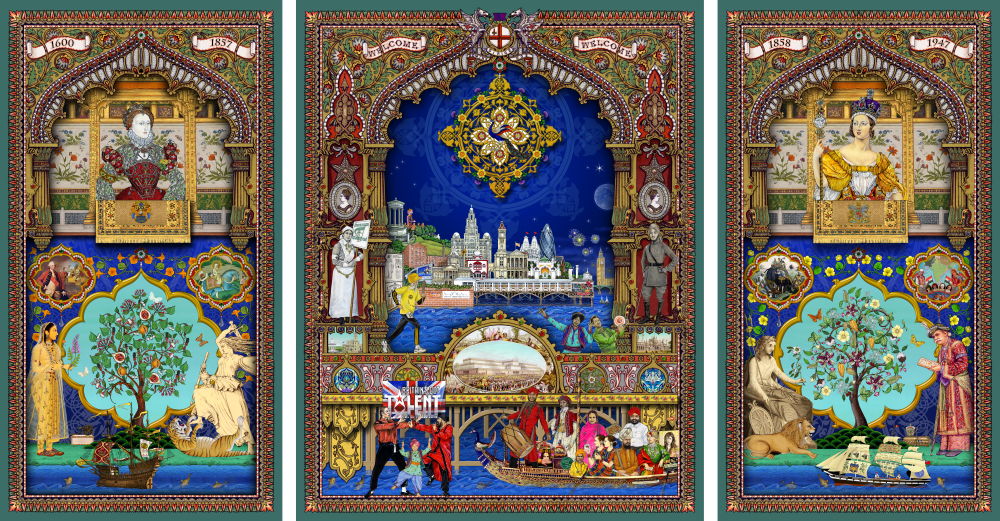
Rule Britannia by The Singh Twins
A few years ago I went to a concert in Clare College Chapel. where a young friend Lucy, played the flute. Above her was a beautiful painting of the Virgin Mary assumed into heaven with cherubs on either flank and dressed in an apricot- coloured duchess satin gown. Only after Lucy swept from the stage did I notice she wore the same extravagant frock ‘That’s a coincidence” I exclaimed naively, “No it’s not!” she beamed back at me. She had become the Mother of God for an afternoon.
Elizabeth 1 must be one of the most recognizable figures in history. In the Ditchley Portrait of 1592 she appears as a giantess astride a map of England, her head in the clouds her bejewelled hands in command of the winds, the clouds and sun. She has replaced The Virgin Mary, Queen of Heaven the centre of the religion she replaced.
As the apogee of Tudor monarchy Elizabeth did not go for realism. The red hair and elegant hands are there and the long face, but this was an image to rule the waves and the weather in a bitterly divided country. The portrait is everywhere in the Heong Gallery’s dazzling and disturbing show about Tudor power. In her time the Queen wore masks and in this remarkable exhibition artists have her in a range of manifestations, a mysterious electrically rotating plastic face is lonely on one wall, a work by Matt Collinshaw, other portraits are headless embroidered images ready to pin on a range of ideas connected with her long (1558-1603) reign. For the brilliant Singh Twins from Liverpool (the city of origin for vast swathes of the slave trade) she is the foundation of the unspeakable violence of colonialism. Their beautiful illuminated paintings have elegant appeal until you focus on the tortured black body swinging in agony from a colourful fruit tree. In 1600 she founded the East India Company a canny move to bring the wealth of the East to her small kingdom. Natasja Kensmil from Surinam takes an outsider’s view to unveil the hidden persona and reveal the ageing grotesque face below in her vast canvas - a quasi-pastiche of the late portrait of the Queen by Netherlandish painter Crispin van de Passe.
Even more surprising are the genderqueer antics of Chan Hyo-Bae. Clad meticulously in costumes of the time, he appears as Anne Boleyn the unfortunate second wife of Henry V111 - with a sinister red seam around her neck. And in another picture he is Henry V111 on the throne, a pool of blood emanating from a chalice. We are told this has some religious significance, but I saw it more graphically as the tyrant ankle deep in blood, an aristocratic woman at his side. “I wonder why we don’t condemn Henry V111 more’ remarked my companion Patricia ‘He’s everywhere in Cambridge, outside Trinity College inside King’s”. When you are invited to view our national heroes from an Oriental or Suriname Siân angle you do begin to wonder what history is all about.
The fons et origo of all this imaginative exploration is Dr. Christina Faraday clearly a genius of a historian who has taken this material and developed its potential and meaning in such an intriguing way.
Tudor Contemporary is showing Wednesday- Sunday 12 -5