ROCK & ROLL MAN - ARTS THEATRE
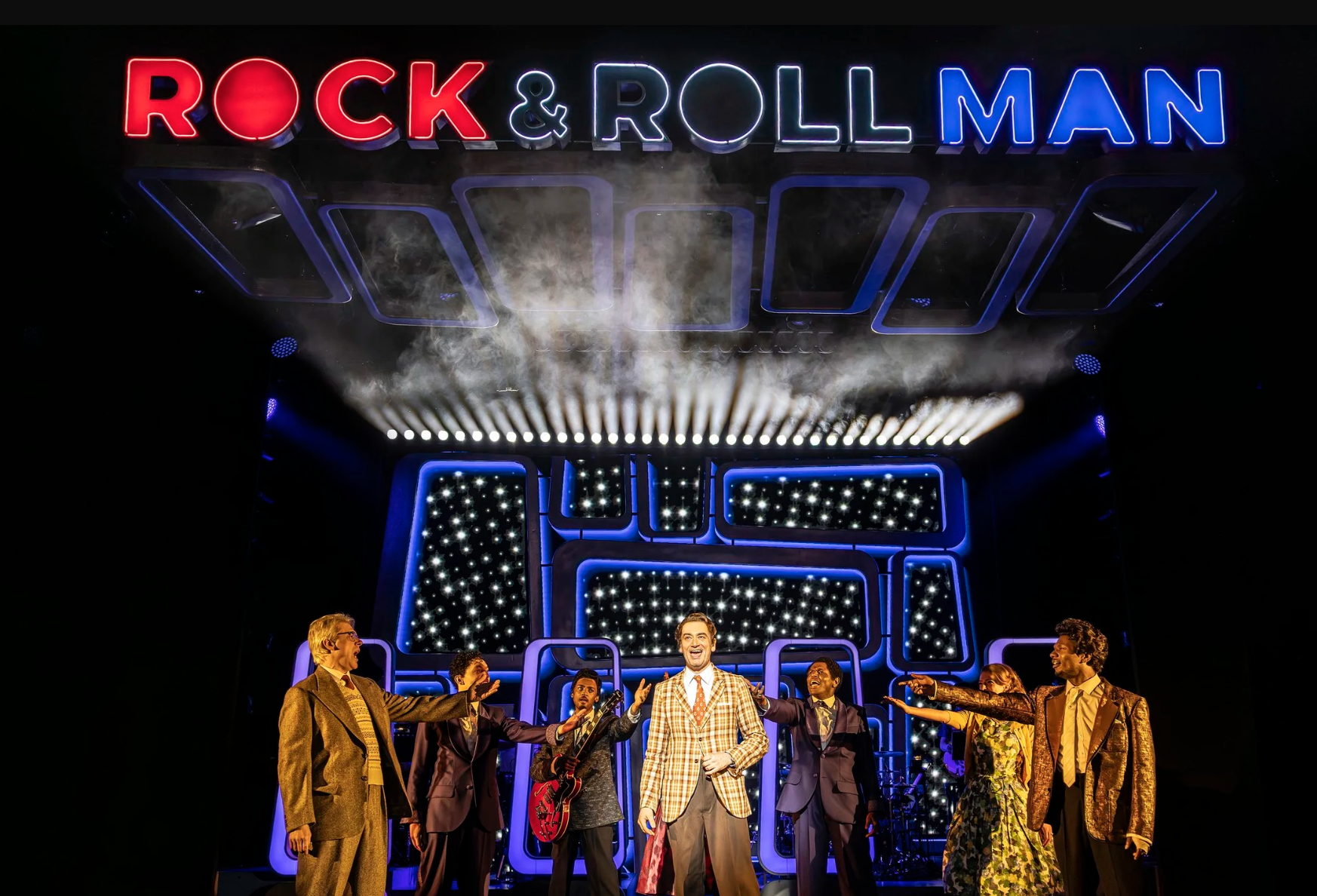
Who rolled out Rock& Roll? Was it invented like the juke box or did it slowly emerge from the dense undergrowth of Blues and Country like some choral Kraken? Rock & Roll Man suggests that 1950s DJ Alan Freed was the eponymous guy who coined the very term and brought the ‘new’ music to the kids of the postwar generation, the first to be seriously dubbed as ‘teenagers’. His radio programme in Cleveland Ohio played the kind of songs that would have been classed as Entartete by the Nazis and as ‘degenerate’ by the bible bashers of McCarthy’s white America. The latter is represented in the show by the powerful then head of the FBI, Herbert Hoover who saw it as his job to sweep up those corrupting Uncle Sam’s children. Freed then is seen as teenage hero to the kids and Public Enemy Number One (especially at his attempts to mix black and white performers in his live shows). Who wins? Middle age repression or Rock & Roll? Guess which!
There is then, as you can imagine, what should be a strong thread of social and political drama here but somehow it doesn’t quite work in this show. The reason is multifold: essentially the production is a juke-box concoction of 50s hits from Little Richard, Jerry Lee Lewis, LaVern Baker and Chuck Berry. Add in the odd song from Buddy Holly and The Platters and how can you go wrong? That said, the show manages to avoid the worst errors of other compilation musicals. It does this by adding in a raft of new songs written in R&R style by Gary Kupper. Though no showstoppers as tunes they do at least move Freed’s narrative arc forward and certainly by the second half we begin to care about him.
Constantine Maroulis, check-blazered in the title role, has presence and vocal authority, and he attacks the material with commitment. But he is not helped by a book that gives him drive without sufficient inner life. Freed often feels less like a fully realised character than a narrative device moving us from one musical number to the next.
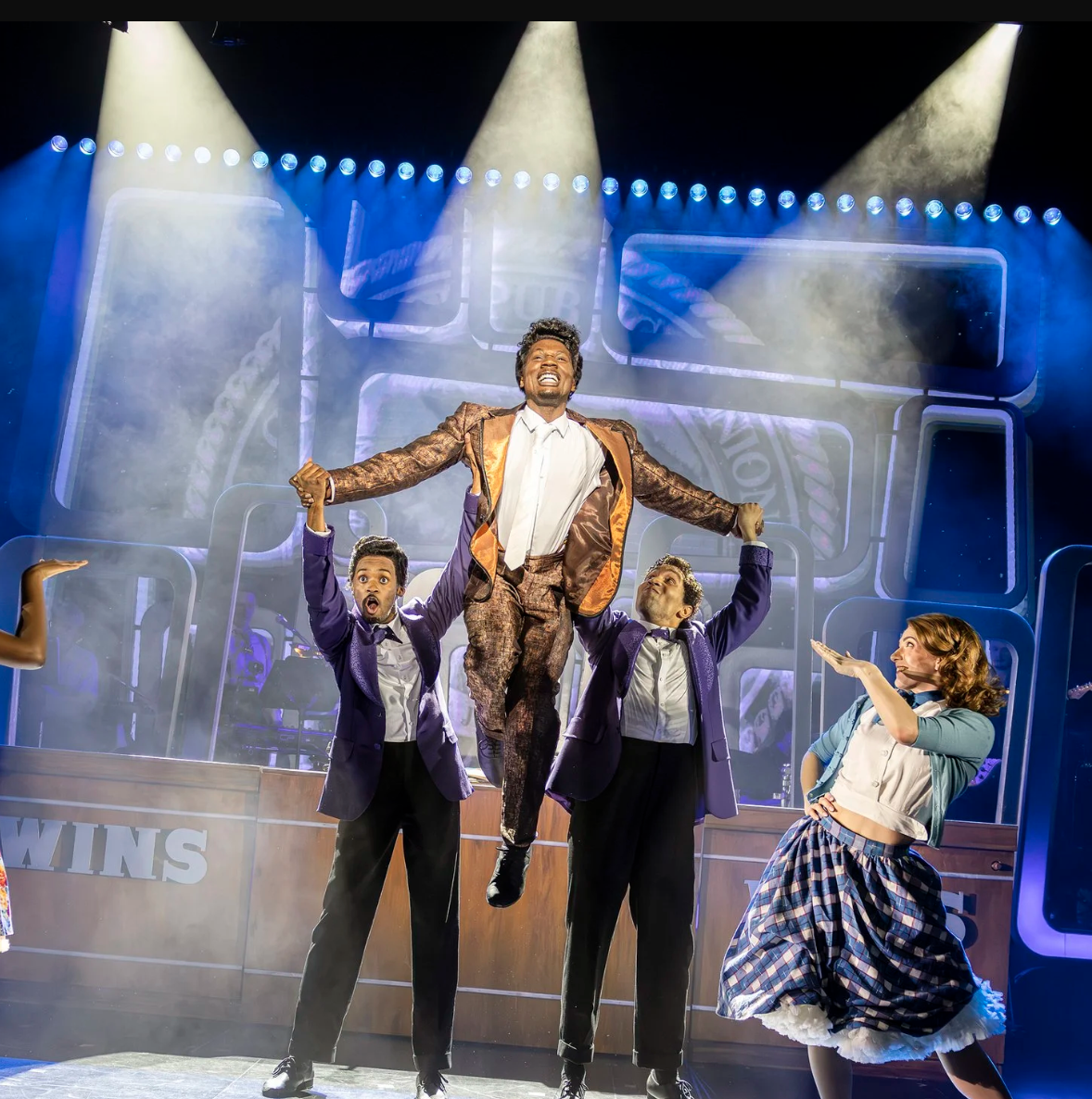
Jairus McClanahan delivers a show-stopping turn as Little Richard, full of charisma and vocal fire. Joey James brings swagger, characteristic duck walking and musical bite to Chuck Berry. Marqise Hairston adds style and vocal strength across multiple roles. Cheriece Richards impresses as LaVern Baker, combining warmth with authority. Shelby Speed, in a range of roles including Freed’s mother, offers some of the few moments of genuine emotional grounding.
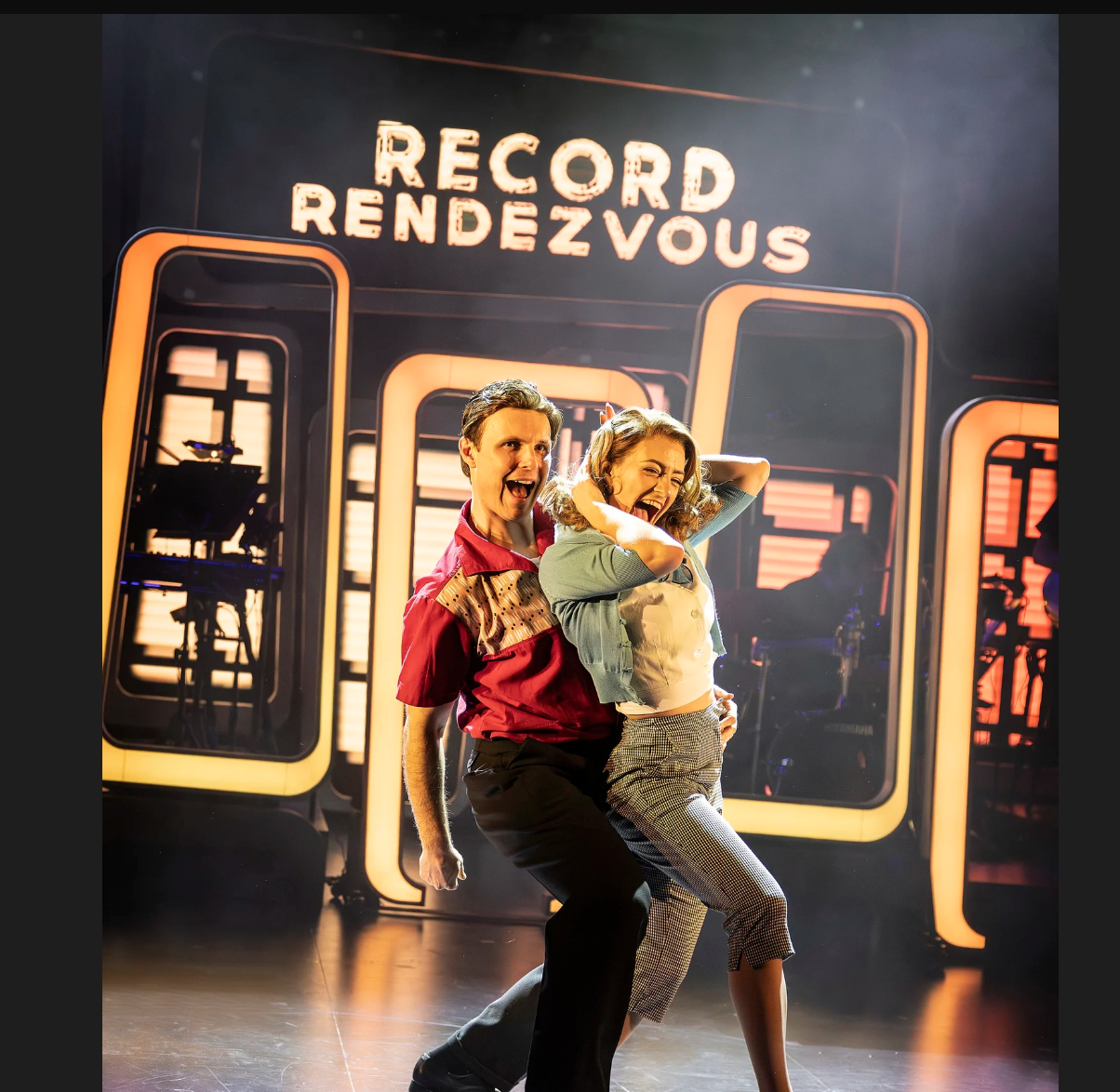
Rock & Roll Man arrives bursting with energy, attitude and a jukebox of irresistible material. The band drives the evening with real punch, the choreography is slick and exuberant, and the production captures the raw excitement of early rock ’n’ roll with undeniable flair. The lighting design is based around a series of rectangles in which characters appear or grainy movie shots are shown. It was outstanding and brought a blaze of colour to the already dazzling production.
But for all its vitality, this show struggles to tell its story. The central problem is apparent from the outset: for much of the first half, we simply don’t care enough about Alan Freed. We are repeatedly told of his importance—the man who helped bring Black music to mainstream white audiences and reshape popular culture—but the show never quite dramatises such importance in a way that engages us. Scenes feel episodic rather than cumulative, relationships are sketched in broad strokes, and Freed himself remains frustratingly elusive.
The result is a first act that feels busy but dramatically slack—full of movement and sound, but lacking a clear emotional through-line. The show entertains, certainly, but rarely compels.
After the interval, things improve. Here, the writing finds greater focus and the stakes begin to register. As the pressures around Freed intensify—commercial pressures, moral compromises, and the looming consequences of the payola scandal—the show finally allows its central figure to come into sharper relief. Maroulis responds with a more nuanced performance, suggesting the cost of success as well as its exhilaration. His decline into drink and poverty is hard to watch.
The ensemble is tireless throughout, sustaining the show’s momentum even when the storytelling wavers. Musically, the production is consistently enjoyable. The numbers are delivered with polish and conviction, and there is an undeniable pleasure in hearing this material performed live with such energy. One leaves, however, with the sense that the show knows what it wants to say—but takes too long to say it.
Rock & Roll Man arrives bursting with energy. It leaves still fizzing—but only intermittently finding the spark that might truly set it alight.