
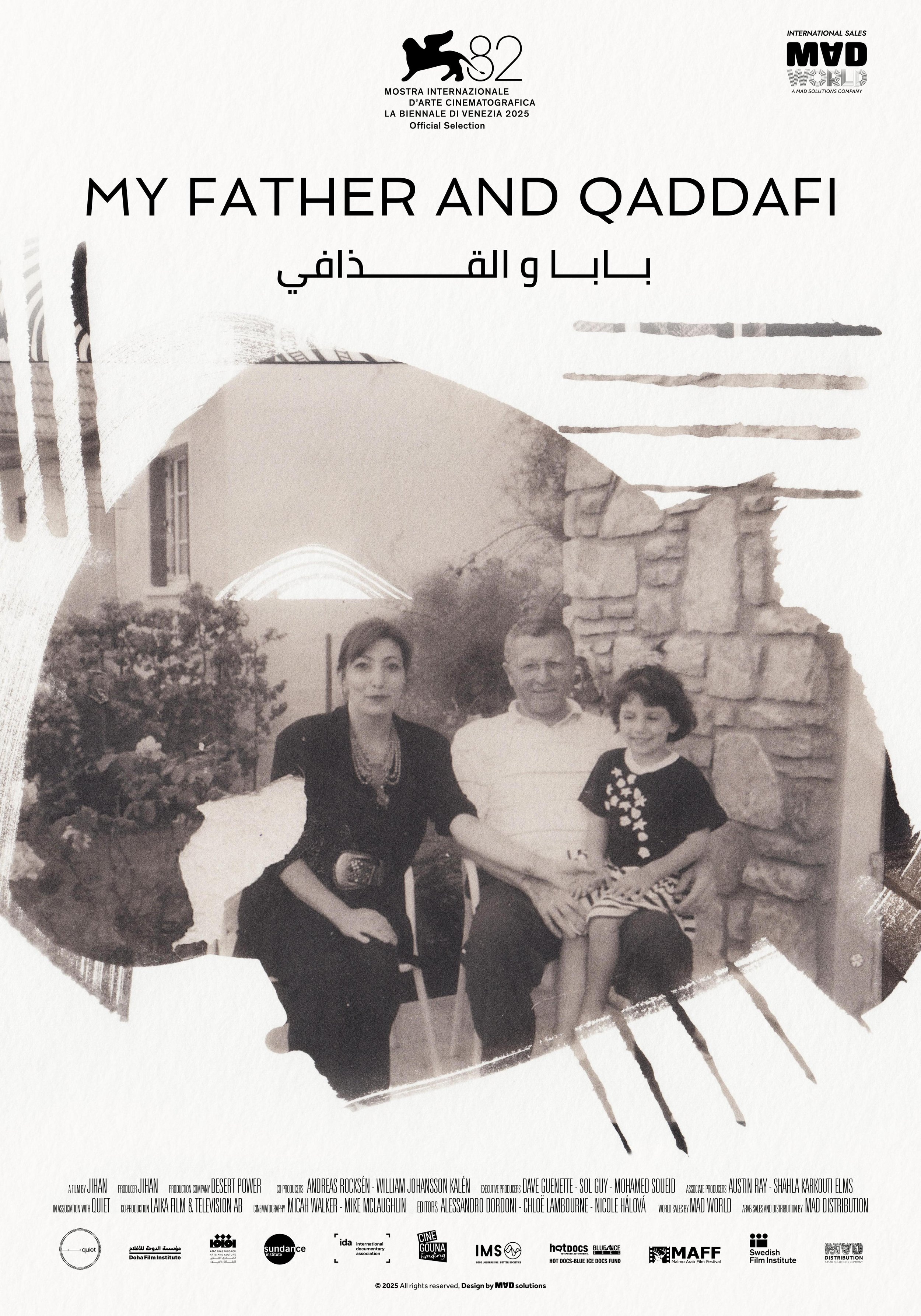
How do you piece together the memories of a father who disappeared when you were just six years old? And how do you reconstruct a childhood overshadowed by the knowledge that somewhere, perhaps, your father is still alive?
These are the questions at the heart of My Father and Qaddafi, a deeply personal documentary by Libyan-American filmmaker Jihan K seen at the Cambridge Film Festival. Her father, Mansur Rashid Kikhia, was no ordinary missing person. A lawyer, former Libyan foreign minister and ambassador to the United Nations, he had become a prominent opponent of Muammar Qaddafi's increasingly tyrannical regime. In 1993, while attending a conference in Cairo, he disappeared. He was never seen alive again by his family.
Kikhia represented a very different vision of Libya from that of Qaddafi. He believed in political reform, human rights and the possibility of peaceful change in a country increasingly dominated by one man's ruthless grip on power. Looking back, one wonders what chance such a progressive figure ever stood against a dictator determined to eliminate opposition.
But although this is ostensibly a film about a daughter's fragmented memories of her missing father, I came away feeling that its real central character was her mother, Baha Al Omary. Here is a woman whose life was turned upside down by her husband's disappearance and who refused, year after year, to abandon the search for him. Her determination to discover the truth becomes the emotional backbone of the documentary. The film itself resembles a jigsaw puzzle whose pieces have been thoroughly mixed up. Jerky, sometimes out-of-focus home movies of Jihan's childhood are interspersed with later interviews with her mother, relatives, her father's associates and others who knew him. There are glimpses of family happiness, of a little girl playing with her daddy, followed by the terrible emptiness of his absence. The filmmaker is trying to put these half-remembered pieces of her childhood back into some sort of focus.
Gradually, through this ever-shifting patchwork of memories and archive footage, the wider political story emerges. We follow Kikhia's rise to prominence, his growing disillusionment with Qaddafi and the dangers faced by those who dared to challenge the regime. Personal tragedy and national history become inseparable. There is also a rather astonishing revelation towards the end, which I shall certainly not spoil here.
Yet for all its emotional power, I found the documentary rather frustrating. Its fragmented structure is understandable, given the nature of the story, but there were moments when I felt the narrative lacked momentum and became repetitive. At 88 minutes, it seemed a touch overlong. More importantly, I was never entirely sure whose story I was watching. The father provides the mystery, the daughter is attempting to solve it, but the mother is surely the person whose courage and determination hold everything together. Jihan herself remains largely behind the camera, although her voice occasionally guides us through the unfolding events. We see plenty of her childhood self, but I would have liked a stronger sense of the adult filmmaker and how this extraordinary family history has shaped her.
Another interesting strand is the question of exile and identity. Jihan and her family find themselves living far from Libya, particularly in the United States, yet their relationship with their adopted country seems uneasy. There is an unmistakable tension between the political ideals they associate with their lost homeland and the capitalist, imperialist world in which they now live. Exile may provide safety, but does it ever provide a genuine sense of belonging? Perhaps that is one of the film's most uncomfortable truths. A dictator does not simply destroy his political opponents. He tears apart families, uproots children, distorts memories and leaves wounds that survive long after his own regime has disappeared.
My Father and Qaddafi is moving, sometimes powerful and occasionally exasperating. A little more narrative discipline would, I think, have made it a stronger film. But its very imperfections perhaps reflect the difficulty of reconstructing a life from scattered memories, political secrets and decades of uncertainty. A touch overlong and, at times, rather out of focus, it nevertheless tells a story worth hearing — not simply about the cruelty of tyranny, but about the terrible price paid by those left behind.