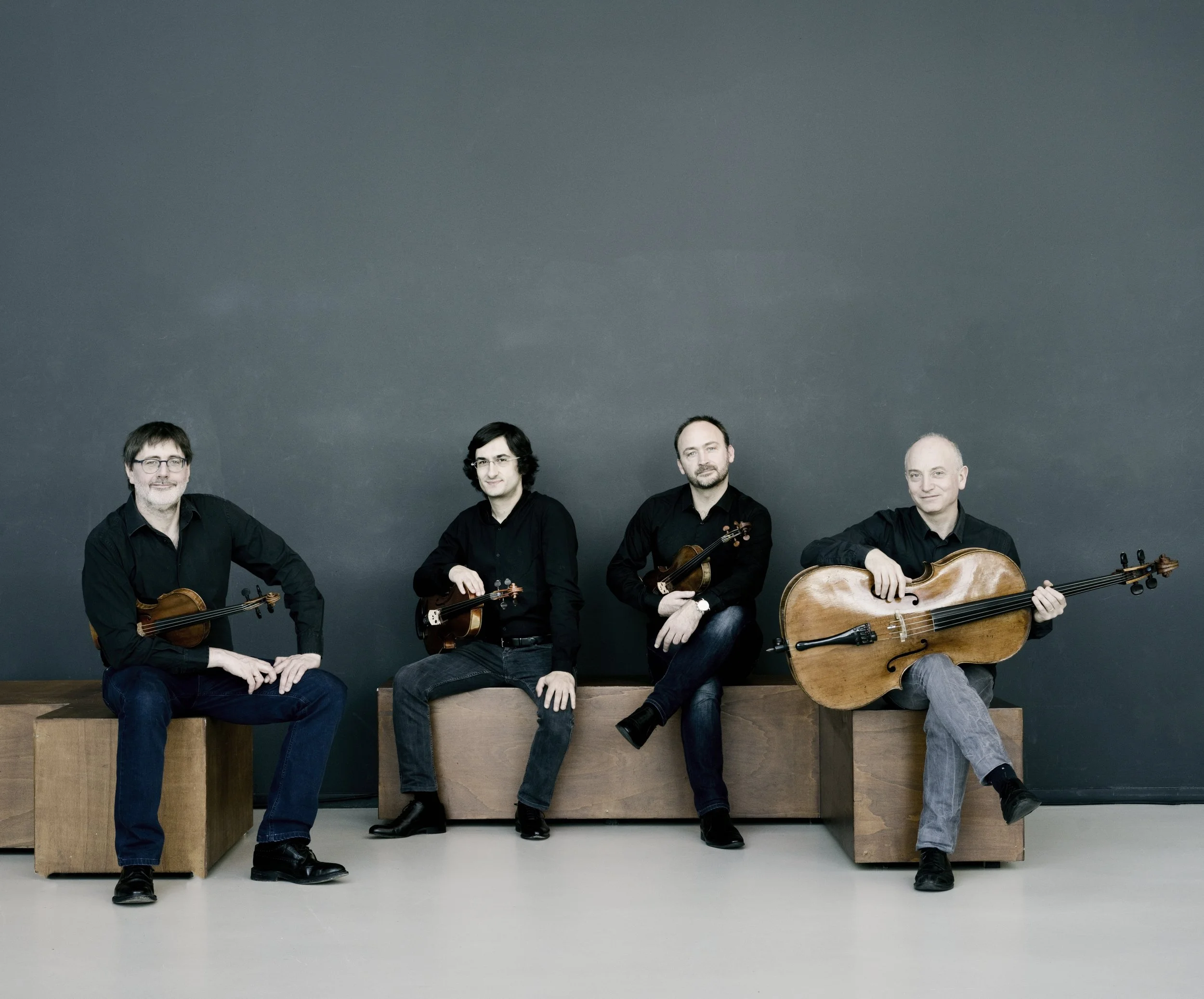
Marc Danel,Vlad Bogdanas,Gilles Millet,Yovan Markovitch left to right.
If you have never heard of Weinberg, let alone listened to his music, you are not alone. But one glance at his life story is enough to know where he comes from. He graduated from the Warsaw music Conservatory in 1939 and he was Jewish. He fled to the Soviet Union, his parents and sister stayed behind only to be murdered. The first chord from Marc Danel’s lead violin fused with Weinberg’s family fate for a moment of transcendent fragility. Beautiful to hear, hard to bear in terms of human suffering.
The Danel Quartet is a dramatic ensemble. In their hands, the very medium of Chamber Music transforms into an emotional experience. Combine that energy with Weinberg’s String Quartet No.7 (1957) and the world of Soviet repression and post Holocaust trauma emerges in all its powerful sense of love and loss. The Adagio trembles with grief and remembrance,whilst Allegretto bursts with life but also with threat. Finally, the links with Shostakovich show up again as a jagged mingle between the Adagio and Allegro, fierce and frightening in parts.
Hardly surprising. Friendship with Shostakovich brought trouble as well as a wonderful influence on Weinberg’s work, imprisoned for post war cultural crimes he was only spared from execution by Shostakovich’ intervention in1948.
How on earth can we have overlooked him – and the passion and precision of the Danel Quartet? Dynamic and daring, they sit on stage with determined style. Giles Millet violin is a handsome gracious contrast to the manic intensity of Marc Danel,whilst the viola player,Vlad Bogdanas from the Czech Republic,looks like a youthful hero of mid -century dramas with his dark curls He has one exquisite solo in the piece.. Cellos - there are now two in the Schubert - feature Yoyvan Markovitch, a small affable player in the style of Endellion’s David Waterman but younger. Petr Parause is anything but small, but his addition lent the Schubert second half real heft as he used his famed skill in masterclasses to support the already well-equipped Quartet.
They must have been keeping it to themselves, but many of us missed the Danel on their last Cambridge appearance in a three- part Shostakovich marathon over two days. Last night, entranced by the bold and expressive playing,we won’t make that mistake again. The Danel is simply unmissable if you want a restored and renewed style of music .
Schubert’s music is rightly revered. It has attracted hyperbole along the lines of “the best the classical genre can produce” and we are told Thomas Mann and Arthur Rubenstein wanted to hear him as they died. The whole hour-long piece was unforgettable. The famous ‘major-minor’ Adagio was sublime - and beautiful.
An eruption of applause had the five back on to the stage three times, finally with a stormy virtuoso finale from everyone.