
A MIRRORED MONET - THE MUSICAL
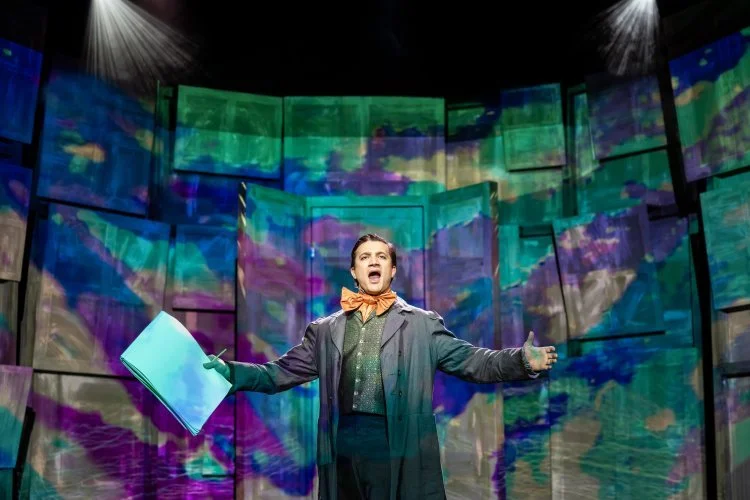
Is there music in painting? Carmel Owen certainly thinks so and infuses her play about Monet with around 25 musical numbers that are meant to provide an aural shimmer to the great master’s Impressionist works. She wrote all the songs – lyrics and music, and the script. Clearly a writer who put Monet where her mouth is.
‘A Mirrored Monet’ begins with a portrait of the artist as an old man, the guns of World War I are in the distance, and he is creatively stuck. His stepdaughter Blanche, an aspiring but gender-blocked artist herself, cares for the old man who has little left except his memories. We then go back in time to his creative blossoming in the 1870s when he hung out with Renoir, Bazille and their aged mentor, Manet. The young radicals are about to turn the salons and the whole art world upside down with their plein air easels, their depiction of ‘ordinary’ folk at work and play and their obsession with light and colour. Of course we know they are to be rejected by the salon superiors, but their day will come.
Into this mix comes the personal story of the younger Monet and his model and lover Camille. Though madly in love, he turns out to be a cad and cares little for Camille’s out of wedlock pregnancy and later child-rearing ‘distractions. The play pivots back and forth with the ageing Monet looking on at his younger self and cursing his short-sighted stupidity (though the way he treats Blanche suggests he has learned nothing and is as emotionally intelligent as a water lily.
So, does this promising scenario work? Alas not. But first the positives: the video projections of an ever-shifting collection of paintings was jaw-droppingly stunning. The works appeared as if by magic into their frames which totally surrounded the action. It was beautiful.
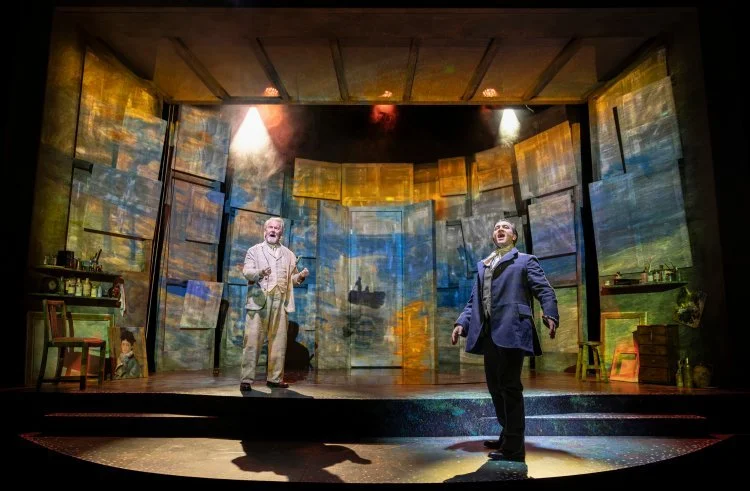
Jeff Shankley was outstanding as the older Monet – gruff voiced and burly, larger-than-still-life and excellent as a man pained with regret. Brooke Bazarian sang beautifully and brought out the bitter pathos but also steely resolve of the spurned Camille. The rest of the cast were fine too.
But, but. The production was a classic example of how NOT to write a musical. Far too many songs, all bar one, instantly forgettable (most like Sondheim on a bad day) and with the clunkiest lyrics. One example of the last was the rhyme ‘She’s like a lonely starling, the poor darling’. Now, I am no twitcher but when did you see a lonely starling, surely one of the most gregarious of birds?
The songs rarely moved the action forward but were inner thoughts of what has already happened. There was a particularly dull one sung (albeit very well) by ‘Marquis’, the salon chief, about the loss of the good old days of the French masters. A sort of ‘they don’t paint them like that any more!’. It would have worked well as a monologue, but the turgid tune and crass lyrics had the effect of making our seats feel harder.
There was one song, ‘There are no stars’ sung by Camille that had an attractive Lloyd-Webber feel to it, but the rest were better forgotten. The script was also clunky – so much exposition of the ‘Our Prime Minister, M. Clemenceau is coming to see you Papa’ type.
The sum total of this production at the quirky and rather loveable Charing Cross Theatre (a former music hall under the railway arches), was of a musical without real dramatic drive, little tension and one-noted regret. True, the finale with the old man trying to reach out to the long-gone Camille was very touching, but as for the rest, I love music, I love art, but here at least, the two were not blessed pair of sirens.
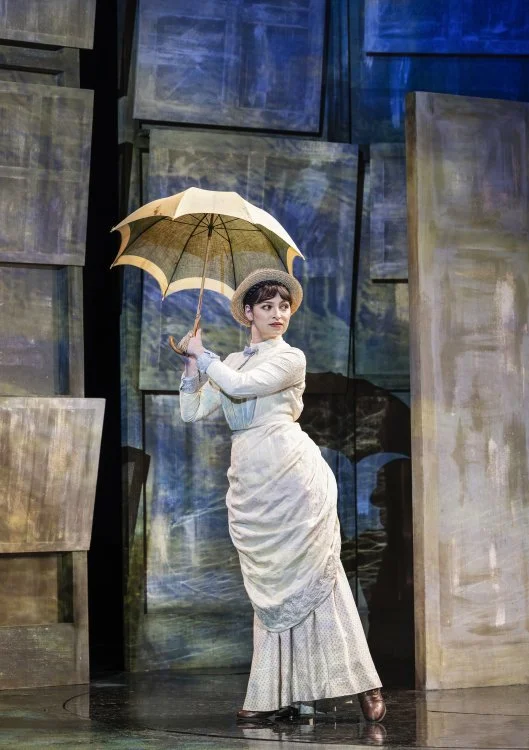
Photo credit; Pamela Raith